
610-459-9646
sales@sciotex.com
ENGINEERING GUIDE
Prototype Development: From Proof of Concept to Production
How industrial and scientific systems move from an idea to a proven, production-ready design: the stages of prototype development, what each one proves, and how 3D CAD, testing and scale-up planning reduce risk along the way.
Last updated October 2026 · Written by Sciotex Engineering
DEFINITION
What is prototype development?
Prototype development is the staged process of turning an idea into a working, tested design: proving the core concept, building and testing functional prototypes, and refining the design until it is ready to be built, installed and supported in production.
The terms are often mixed up. A proof of concept shows that the core idea works, usually on a bench with whatever hardware is at hand. A prototype is a working version of the system, built to test the whole design. A pilot or pre-production unit runs in the real environment to prove the design is repeatable. An MVP, a term from software startups, is the smallest version that delivers value to real users.
This guide covers prototype development for industrial and scientific systems, such as inspection machines, counting and sorting systems, test and measurement systems, scientific instruments and custom automation. Sciotex develops these from concept to full turnkey systems and scale-up, with mechanical, electrical and software design under one roof and everything modeled in 3D CAD before it is built.
STAGES
The stages of prototype development
Good R&D moves in stages, each one answering the biggest remaining question for the least money. A decision gate between stages keeps a project from spending production money on an unproven idea.
Along the way, different kinds of prototypes answer different questions:
Proof-of-concept prototype
A bench setup that proves the core physics, measurement or algorithm works.
Digital prototype
A 3D CAD model that shows layout, motion and clearances before anything is built.
Looks-like prototype
A model of the size, form and operator experience, often 3D printed.
Works-like prototype
A functional system that performs the job, even if it doesn't look final.
Engineering prototype
A near-final design used to verify performance, reliability and serviceability.
Pilot or pre-production unit
A production-intent system running in the real environment.
STAGE GOALS
What each stage of prototype development proves
Each stage should end with evidence and a decision, not just a deliverable. Knowing what a stage must prove keeps it focused and cheap.
| Stage | Main question | Typical output | Decision at the end |
|---|---|---|---|
| Feasibility study | Can it be done, and is it worth doing? | Report, risk list, concept layout, rough budget | Go or no-go |
| Proof of concept | Does the core idea work? | Bench test and measured results | Commit to a prototype |
| Functional prototype | Does the whole system work together? | Working unit and test data | Refine or redesign |
| Pilot / pre-production | Does it work in the real environment, repeatably? | Unit in production or lab use | Release to production |
| Production | Can it be built, installed and supported at scale? | Documented design and turnkey systems | Scale up |
Swipe the table to see all columns →
Stages map closely to technology readiness levels (TRL), and the first gate is usually an engineering feasibility study.
DISCIPLINES
The engineering disciplines in a prototype
Industrial and scientific systems fail at the boundaries between disciplines: a mechanism that vibrates the camera, wiring that picks up noise, software that can’t keep up with the motion. Designing them together avoids most of those surprises.
Mechanical design
Frames, fixtures, part handling, motion and enclosures, modeled in 3D CAD to check fit, reach, clearances and serviceability before fabrication.
Electrical design
Control panels, power, wiring, sensors, I/O and safety circuits, designed alongside the mechanics so routing and access work in the real machine.
Software and controls
Machine control, test sequencing, data acquisition and operator interfaces in LabVIEW, C#, C++, Python or PLCs. See industrial software development and LabVIEW development.
Vision, optics and measurement
Cameras, lighting, line-scan imaging, lasers and sensors, chosen and tested on real samples. See machine vision and data acquisition.
3D CAD
Model it in 3D before you build it
Sciotex models systems in 3D CAD before building them. A shared 3D model lets everyone see the machine, find problems and agree on the design while changes still cost minutes instead of rework.
POC OR PROTOTYPE?
Proof of concept or functional prototype first?
Not every project needs every stage. The question is how much is still unknown.
Start with a proof of concept when…
- The core physics, measurement or algorithm has never been tried this way
- Success depends on detecting something small, fast or subtle
- You need evidence before asking for a full budget
- Several competing approaches need a quick comparison
- Real samples might behave differently from expectations
Go straight to a functional prototype when…
The core technology is proven and the risk is in integration: making mechanics, electronics, optics and software work together at speed, reliably, in a real environment. A 3D CAD model and a focused test plan can stand in for a separate proof-of-concept stage.
APPLICATIONS
Where industrial R&D and prototyping are used
Sciotex prototypes and builds the same kinds of systems it delivers in production. These are the most common.
1Inspection and vision systems
New inspection methods for defects, dimensions and surfaces, proven on real samples first. See vision systems.
2Counting and sorting machines
High-speed counting and sorting for parts, seeds and materials. See the automated counting guide.
3Test and measurement systems
Custom test stations and measurement rigs for new products. See the automated test equipment guide.
4Scientific instruments
Microscopes and lab instruments taken from research prototype toward commercialization. See the light sheet microscopy guide.
5Process and pilot-plant systems
Control and monitoring for pilot plants and scale-up. See the process control guide.
6Custom automation and robotics
One-of-a-kind machines and cells where no standard machine exists. See the industrial automation guide.
TO PRODUCTION
How to take a prototype to production
A prototype that works once is not a product. Getting to production means making the design repeatable, buildable, installable and supportable. See prototype to production.
1. Define requirements
What the system must do, how fast, how accurately, where it runs and who uses it.
2. Prove feasibility
Test the riskiest ideas first, on real samples, before designing the whole system.
3. Design in 3D CAD
Model mechanics, electrical layout and operator access before building anything.
4. Build and test the prototype
Integrate mechanical, electrical and software, then test against the requirements.
5. Pilot and refine
Run in the real environment and fix what only real use reveals.
6. Scale up and support
Documented, turnkey systems built in quantity and supported for the long term.
LATE CHANGES
Why staged prototyping pays: the cost of late changes
The cost of fixing a design problem grows at every stage. Staged R&D is about finding problems while they are still cheap.
Example. A camera that can’t see a feature because a bracket is in the way takes minutes to fix in the 3D model. Found on the prototype, it means new parts and a reassembly. Found after several systems have shipped, it means a retrofit on every one of them, often at customer sites.
The same logic applies to performance. Proving on real samples early that a defect can actually be detected, or that a part can be handled at speed, is far cheaper than discovering it on a finished machine.
REAL-WORLD EXAMPLES
Systems Sciotex has taken from concept to reality
Each of these began with a question nobody had a standard answer to, and became a working system through staged development.
Seed Counter
Counts and measures seed at up to 2,000 per second, using two camera views to separate overlapping seeds.
View example →
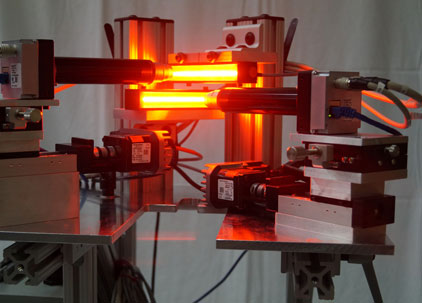
Extrusion inspection system
Inspects long extrusions inline or offline, classifies each part and sorts by defect severity.
View example →
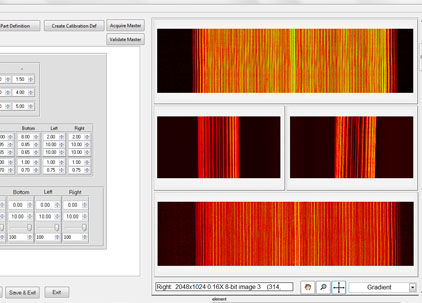
Fiber optic draw tower inspection
Two line-scan cameras with microscope objectives find defects as small as 20 µm in moving fiber.
View example →
Web inspection system
Line-scan inspection of continuous fiberglass webs used in wind turbine blades.
View example →

Multiview light sheet microscope
Research microscope control software, part of microscopy work carried from concept to commercialization.
View example →
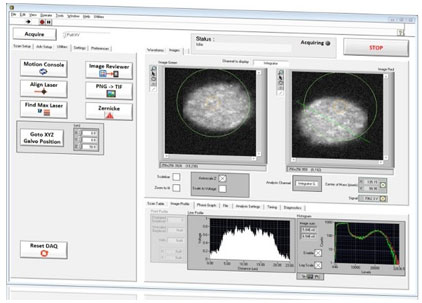
Adaptive optics microscope
Control and analysis software for a custom adaptive optics two-photon research microscope.
View example →
KEEP LEARNING
Industrial R&D articles
Technology Readiness Levels (TRL) Explained
The nine TRL levels and what they mean for industrial and scientific systems.
Read article →
Engineering Feasibility Studies
What a technical feasibility study answers before you build.
Read article →
Prototype to Production
Taking machines, test systems and instruments from one unit to many.
Read article →
System Re-Engineering
Replacing legacy test and automation systems when designs are missing.
Read article →
Reverse Engineering Legacy Software
Recovering logic and behavior from undocumented industrial software.
Read article →
Custom Automation Equipment vs Off-the-Shelf
When a custom-built machine is the right answer.
Read article →
FAQ
Prototype development FAQs
What is prototype development?
The staged process of turning an idea into a working, tested design: proving the core concept, building and testing functional prototypes, and refining the design until it is ready for production.
What are the stages of prototype development?
Typically feasibility, proof of concept, functional prototype, pilot or pre-production, and production, with a go or no-go decision between each stage.
What is the difference between a proof of concept and a prototype?
A proof of concept shows that the core idea works, often on a bench. A prototype is a working version of the whole system, built to test how everything performs together.
What is a functional prototype?
A prototype that actually performs the job, with working mechanics, electronics and software, even if it does not yet look or perform like the final design.
Why model a prototype in 3D CAD first?
A 3D model shows layout, motion, clearances and access before anything is built, so problems are fixed in minutes instead of through rework, and everyone can review the same design.
How do technology readiness levels relate to prototypes?
TRL describes how mature a technology is, from basic principles (TRL 1) to proven in operation (TRL 9). Prototype stages move a system up that scale. See technology readiness levels.
Can a prototype be scaled up to turnkey production systems?
Yes, when the design is documented and refined for building, installing and supporting it repeatedly. Sciotex develops systems from concept to full turnkey and scale-up.
Does Sciotex do mechanical, electrical and software design?
Yes. Sciotex handles mechanical, electrical and software design in-house, models everything in 3D CAD and delivers anything from a proof of concept to full turnkey systems.
Have an idea that needs proving?
Sciotex takes industrial and scientific systems from concept to full turnkey production, with mechanical, electrical and software design under one roof and every design modeled in 3D CAD. Talk to our industrial R&D engineering team.

© Copyright 2026 by Coleman Technologies, Inc. DBA Sciotex