
Custom ATE Systems
ATE Systems: Custom Automated Test Systems for Production and R&D
Sciotex designs, programs and builds automated test equipment around your product: the instruments, switching, fixtures and test software that measure every unit, decide pass or fail and record every result. Designed, programmed, built and supported in the US since 1997.
Last updated: October 2026 · Sciotex Engineering Team
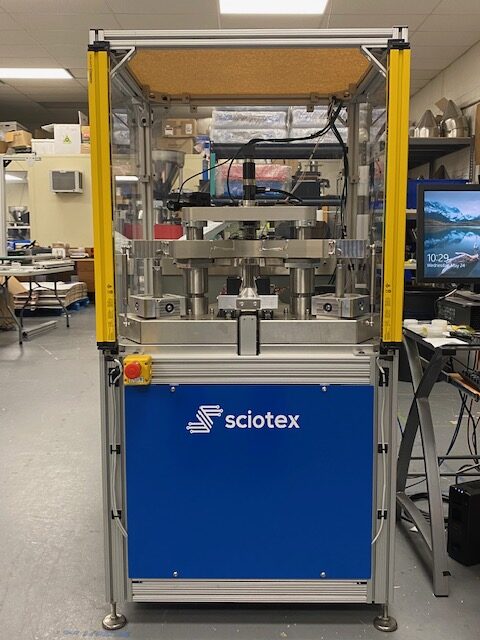
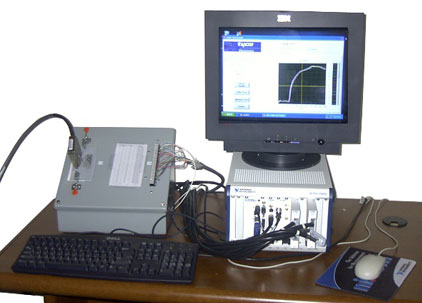
NI and LabVIEW integrator
NI hardware with LabVIEW and TestStand, plus other instruments where they fit better.
Built and supported in the US
Designed, programmed and built in Pennsylvania.
The Short Answer
What Is an ATE System?
An ATE system (automated test equipment) is a computer-controlled test station that applies power and signals to your product, measures how it responds, compares each result with pass/fail limits and records it against the serial number, with no operator judgment involved.
Off-the-shelf testers cover standard devices. A custom ATE system is built around your product: its connectors and fixture, its signals and tolerances, your takt time, and the data your quality system needs. For the engineering background, read our ATE engineering guide.
What You Get
What's in a Sciotex ATE System
A rack of instruments is not a test system. Every Sciotex ATE system is delivered as a working, documented test station.
Test strategy and specification
Tests, limits, guardbands and coverage defined from your product requirements.
Instruments, switching and fixtures
NI PXI, DAQ and bench instruments, relay switching, mass interconnect and custom fixtures.
Test software and data
Sequencer, operator screens, limits control and results to your database or MES.
Validation and support
GR&R studies, documentation, training and support for the life of the station.
Want the engineering detail? See our test fixture design guide and automated test software.
Proof, Not Theory
ATE Systems Sciotex Has Built
Each system below was engineered around a specific product, its tests and its users.
Ring Laser Gyro Test System
Over 60 high-speed digital and analog channels screen navigation-grade gyros.
View system →
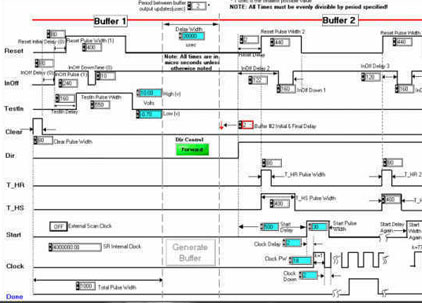
ASIC Functional Test System
User-defined high-speed digital patterns in; output timing and amplitude analyzed.
View system →
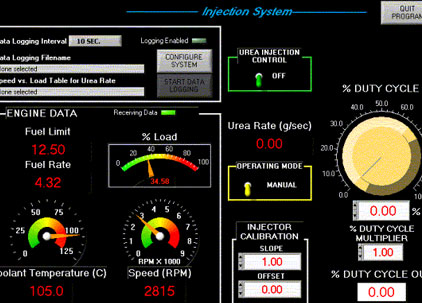
Automotive CAN Bus Tester
Reads a vehicle computer over CAN and drives test conditions from the data.
View system →
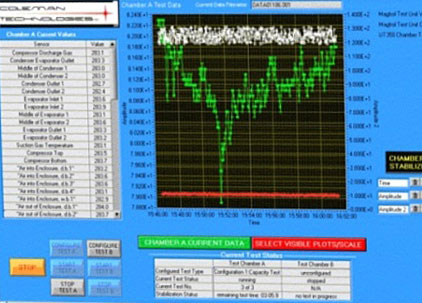
Environmental Chamber Test
Two chambers, 60+ thermocouples, GPIB instruments and recipe control.
View system →
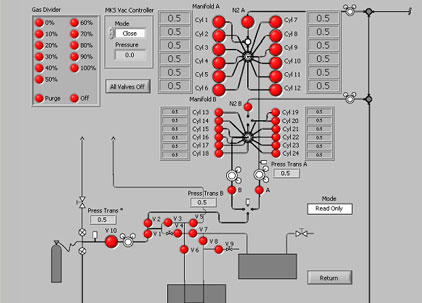
Automated Gas Tester
FTIR analysis of mixed-gas purity with database-driven criteria.
View system →
Cable Test System
Automated electrical checks of cable assemblies.
View system →
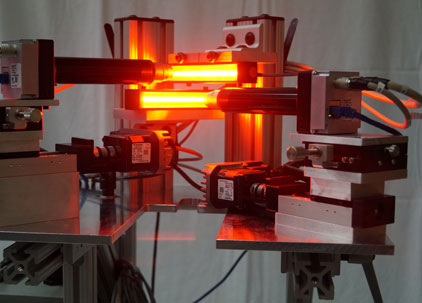
Fiber Optic Test System
Microscopic defect detection on the draw tower during production.
View system →
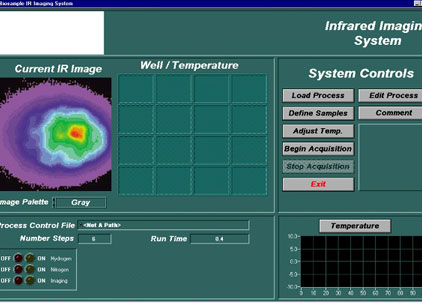
Biological Sample IR Analyzer
Automated infrared analysis of biological samples.
View system →
Find Your Application
ATE Systems by Application
Automotive and EV test
ECU, CAN bus, sensor and battery-module testers with full traceability.
Aerospace and navigation
High-channel-count test of gyros, avionics and precision assemblies.
Semiconductors and electronics
ASIC, wafer, board and module test with high-speed digital and analog.
Environmental and reliability
Chamber control, loads and many sensors with recipe-driven test profiles.
Cables, connectors and relays
Continuity, insulation and switching tests through custom fixtures.
Test stands and data acquisition
Measurement-heavy test stands built on custom data acquisition systems.
Compare Your Options
Types of ATE Systems
Automated test systems differ in how they contact the product, which instruments they need, and how much throughput and flexibility they must deliver.
| Type | How it works | Best for | Sciotex system |
|---|---|---|---|
| Production functional and end-of-line tester | Fixture-based station that powers, exercises and judges every unit | Production lines driven by takt time | Automotive CAN bus tester |
| PXI and rack-mounted ATE | Modular instruments with shared timing in a rack | High-mix products, many signal types | Ring laser gyro test system |
| Environmental and reliability test | Chambers, loads and many sensors under recipe control | Qualification, burn-in, thermal and HVAC testing | Environmental chamber test system |
| Semiconductor and device test | High-speed digital patterns and precise analog measurements | ASICs, wafers and components | ASIC test system |
| Cable, connector and relay test | Continuity, shorts, insulation and switching checks through mating fixtures | Harnesses, connectors and relays | Cable test system |
| Process and analytical test | Analyzers, flow, pressure and gas handling under automated control | Gas, optical and chemical products | Automated gas tester |
Off-the-shelf tester or a custom ATE system?
A standard tester is the right buy for some jobs. This is how to tell which side of the line your project is on.
| Off-the-shelf tester | Custom ATE system | |
|---|---|---|
| Best for | Standard devices with established test methods | Your product, your fixture, your takt time and tolerances |
| What you get | A platform you program and fixture yourself | Instruments, fixtures, software and integration working as one station |
| Who makes it work | Your test engineering team | Sciotex, accountable for the result |
| Data | Logs and reports in the vendor format | Results by serial number to your database, MES or SPC |
| Support | Vendor support for the product | Support for the whole station over its life |
It isn’t either/or. As an NI and LabVIEW integrator, Sciotex builds custom ATE around off-the-shelf NI and other instruments, and adds custom fixtures and electronics only where they are needed.
Choosing the details: in-circuit vs functional test · end-of-line testing · HIL testing · measurements to automate
The Business Case
What a Custom ATE System Pays Back
Faster test cycles
Seconds per unit instead of minutes at a manual bench, with parallel testing where it pays.
Fewer escapes and false failures
Guardbanded limits and validated measurements catch bad units without rejecting good ones.
Operator-independent results
The same procedure on every unit, every shift, regardless of who runs the station.
A record of every unit
Every measurement stored against the serial number for audits, warranty and yield analysis.
The return comes from labor saved at manual test benches, fewer defective units reaching customers, and yield data that drives process fixes. We help you estimate it during the requirements review.
Working With Sciotex
How an ATE Project Works
1. Requirements and test strategy
Product specifications, tests, limits, takt time and data needs reviewed.
2. Architecture and proof of concept
Instruments and fixture approach proven on your critical measurements.
3. Design
Fixture, switching, wiring, enclosure, safety and software designed and reviewed.
4. Build and program
Station built, programmed and debugged with your units in our shop.
5. Install, validate and support
Commissioned, validated with GR&R, documented and supported for its life.
What to send for a quote
The right tester depends on your product and production goals more than on instrument brand.
- Product or test specification, with limits
- Drawings, connectors and photos of the unit under test
- Required throughput (units per hour) and number of variants
- Existing test procedures, fixtures or stations, if any
- Data, traceability and MES requirements
Why Sciotex
Why Work With an ATE Systems Integrator
An instrument vendor sells you hardware. An integrator is accountable for the result: a station that tests the right things, at your takt time, with data you can trust.
NI and LabVIEW integrator
NI PXI, CompactRIO and DAQ hardware with LabVIEW and TestStand, plus other instruments where they fit better.
In-house software
LabVIEW, TestStand, Python and C# developers, including Certified LabVIEW Developers and Architects.
Lower project risk
Test strategy and proof of concept first, so the station works before it is built in full.
Supported for the long term
Documentation, training and support for the life of the system.
Trusted by the most innovative organizations














Before You Buy
ATE Systems FAQ
What is an ATE system?
An ATE system, or automated test equipment, is a computer-controlled test station that applies power and signals to a product, measures its response, compares results with pass/fail limits and records them, without relying on operator judgment.
What does a custom ATE system cost?
Cost depends on the number and type of tests, instrument accuracy, fixture complexity, handling and automation, safety requirements, software and data features, and the number of product variants. We scope it with you during a requirements review, so you only pay for the capability you need.
What do you need from us to quote an ATE system?
A product or test specification with limits, drawings or photos of the unit under test and its connectors, the required throughput and number of variants, any existing test procedures or stations, and your data and traceability requirements.
Do you work with NI hardware, LabVIEW and TestStand?
Yes. Sciotex is an NI and LabVIEW integrator, with Certified LabVIEW Developers and Architects. We build test systems on NI PXI, CompactRIO and DAQ hardware with LabVIEW and TestStand, and integrate other instruments where they fit the application better.
Can you build a proof of concept first?
Yes. For new or difficult measurements we prove the instruments and fixture approach on your units before the full station is built, which reduces risk and firms up cost and schedule.
Can you upgrade or support an existing test system?
Yes. We replace obsolete instruments and controllers, rewrite or extend test software, add data logging and MES connections, and support systems built by others.
How long does an ATE project take?
It depends on the number of tests, fixtures and stations, and on whether a proof of concept is needed. We give you a schedule after the requirements review, with milestones for design, build, validation and installation.
Can the test system connect to our MES, database or PLC?
Yes. Sciotex test systems can log results to SQL databases, exchange data with MES, read serial numbers, print labels and communicate with PLCs and line controls.
Free Consultation
Discuss Your Test Project
Share your product, what needs to be tested, your throughput and how results will be used. We’ll recommend an approach and tell you what it takes to build it.
Learn the Technology
Related Guides
The Complete ATE Guide
Architecture, test methods, fixtures, software and how to choose an automated test system.
End-of-Line Testing
How EOL test stations work and how to size them to your line rate.
Test Fixtures
Bed-of-nails, pogo pin and functional fixtures, and how to design for test.

© Copyright 2026 by Coleman Technologies, Inc. DBA Sciotex