
LabVIEW Consulting · NI and LabVIEW Integrator
LabVIEW Consultant, Programmer & Developer Services
Certified LabVIEW developers and architects who build, support and upgrade LabVIEW applications for test, data acquisition, machine vision and process control. Sciotex is a full-service US engineering firm founded in 1997, so architecture, code, hardware integration and long-term support come from one team.
Last updated: October 2026 · Sciotex Engineering Team
Certified LabVIEW Developers and Architects
CLD programmers, with many engineers certified as LabVIEW Architects.
Built and supported in the US
100% US-based engineering team in Pennsylvania.
The Short Answer
What Does a LabVIEW Consultant Do?
A LabVIEW consultant designs, writes, fixes and supports LabVIEW applications that control hardware, acquire data and automate tests. Sciotex LabVIEW consultants take a project from requirements and architecture through code, hardware integration and deployment, then provide LabVIEW support for as long as the system runs.
Most teams call us for one of three reasons: a new test, measurement or control system needs to be built; an existing LabVIEW application is fragile, slow or was written by someone who has left; or an in-house team needs senior LabVIEW expertise to hit a deadline. New to the platform? See how LabVIEW works and what it’s used for.
LabVIEW Services
LabVIEW Programming and Development Services
Whether you need a LabVIEW programmer for a few weeks or a team to deliver a complete system, the work is done by engineers who build production systems, not just code.
New LabVIEW application development
Test, DAQ, vision, motion and control applications built on proven architectures such as state machines, queued message handlers and the Actor Framework.
LabVIEW support and maintenance
Bug fixes, new features and urgent help for systems in production, from a team that documents what it changes.
Legacy code rescue and upgrades
Refactor fragile VIs, move to current LabVIEW versions and replace obsolete hardware and drivers without losing what works.
TestStand and test automation
TestStand sequences, custom operator interfaces, test executives and reporting built around LabVIEW code modules.
Real-time, FPGA and embedded
LabVIEW Real-Time and FPGA on CompactRIO and PXI for deterministic control, high-speed acquisition and custom timing.
Instrument drivers and integration
Custom drivers for instruments, cameras, PLCs and databases over serial, GPIB, Ethernet, Modbus and CAN.
Hiring for the first time? Read how to vet a LabVIEW consulting firm and our notes on writing LabVIEW instrument drivers.
LabVIEW Support
LabVIEW Support and Legacy Code Rescue
Code audit
We review your VIs, architecture and hardware to find the bugs, bottlenecks and risks, then give you a prioritized plan.
Refactor and stabilize
Monolithic block diagrams become modular, documented code that new engineers can follow and extend.
Upgrade and migrate
Move to a current LabVIEW version, Windows release or NI hardware platform, with regression tests to prove nothing broke.
Ongoing support
Planned enhancements, on-call fixes and knowledge transfer so your system and your team keep running.
Do you have LabVIEW code that is outdated, poorly written or no longer performs? Need features added but the original developer is gone? Sciotex LabVIEW developers clean up the codebase, improve readability and performance, generate documentation and add features, so the system can be maintained for years. Weighing your options? Compare where to get LabVIEW help.
Where LabVIEW Fits
LabVIEW Developers for Test, Measurement and Control
Automated test systems
Production and R&D test stands with LabVIEW, TestStand and NI PXI.
Data acquisition systems
High-speed, multi-channel measurement, logging and analysis.
Process control
Real-time control, recipes and SCADA for pilot and production plants.
Machine vision and inspection
NI Vision with GigE and USB3 cameras for gauging, OCR and defect detection.
FPGA and real-time systems
LabVIEW FPGA and Real-Time for deterministic, low-latency control.
Industrial AI
AI models deployed alongside LabVIEW test and inspection systems.
Proof, Not Theory
LabVIEW Systems Sciotex Has Built
Most Sciotex systems are written in LabVIEW. A few examples from test, research and production:
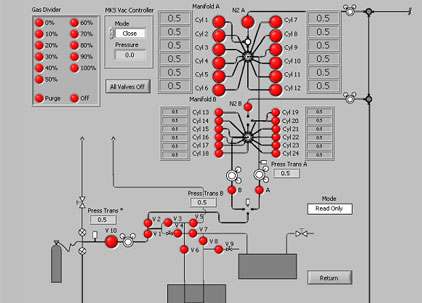
Automated Gas Tester
FTIR gas analysis with barcode scanners, pressure and flow controllers, FieldPoint I/O and database test criteria.
View system →

Screen Printing Vision System
A LabVIEW vision program that grades decorated dishware as good, minor or major defect for sorting.
View system →
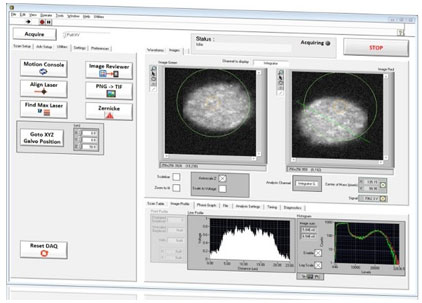
Adaptive Optics Microscope
Control and image-correction software for an adaptive optics research microscope.
View system →
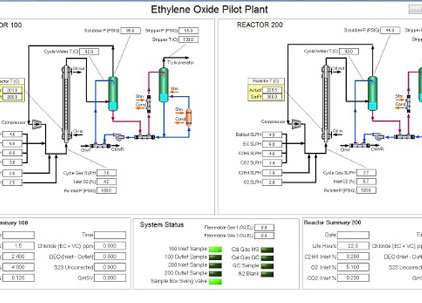
Ethylene Oxide Pilot Plant
SCADA for an ethylene oxide pilot plant on NI Compact FieldPoint real-time hardware.
View system →

Scientific Vision Software
GPU-accelerated vision algorithms and inspection systems for research and fiber optics.
View system →
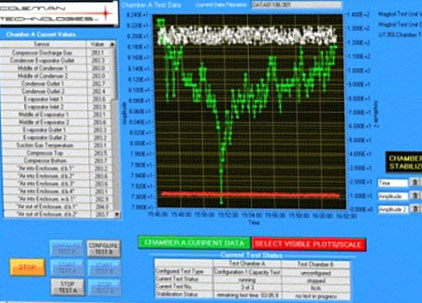
Automated Test Systems
Ring laser gyro, ASIC, relay, automotive and environmental chamber test systems.
View system →
Ways to Engage
How to Work With a LabVIEW Consultant
Pick the engagement that matches how well defined the work is. Many clients start with a code review or proof of concept, then move to a fixed-price build.
| Engagement | How it works | Best for |
|---|---|---|
| Fixed-price project | Scope, deliverables and price agreed up front, with milestone demos | New systems with clear requirements |
| Time and materials | Billed for hours worked, with regular status updates and demos | R&D and requirements that are still changing |
| Ongoing LabVIEW support | Planned enhancements, periodic code reviews and on-call fixes | Production systems that must keep running |
| Code review and assessment | We audit your code and hardware and deliver a written plan | Inherited, unstable or slow applications |
| Team extension | Our LabVIEW developers work inside your project, on-site or remote | In-house teams facing a deadline or skills gap |
Swipe the table to see all columns →
Hire in-house or use a LabVIEW consultant?
Hiring in-house often means months of recruiting and training while test or automation projects stall. A LabVIEW consultant gives you senior engineers immediately, and you scale the expertise up or down as the work changes.
| Hire an in-house LabVIEW developer | Use a LabVIEW consultant | |
|---|---|---|
| Time to start | Months of recruiting and onboarding | Discovery within 48 hours; projects in about 2 weeks |
| Expertise | One person’s experience | A team of CLDs and CLAs with hardware experience |
| Cost | Salary and benefits all year | Pay for the work; scale up or down |
| Risk | Knowledge leaves when the person does | Documented code and knowledge transfer |
| Best for | A constant, long-term LabVIEW workload | Projects, peaks, specialist work and rescue |
Swipe the table to see all columns →
It isn’t either/or. Many clients keep a small in-house team for day-to-day changes and bring in Sciotex for new systems, architecture and the hard problems.
Choosing a language or test executive? See automated test software options and data acquisition software choices.
Working With Sciotex
How a LabVIEW Project Works
1. Free discovery call
Share your requirements, hardware, timeline and any existing code. We give an initial technical assessment.
2. Requirements and architecture
Detailed requirements, a risk review and an architecture proposal, usually in one to two weeks.
3. Proof of concept
The riskiest functions are proven against your success criteria before the full build.
4. Development
Iterative builds with regular demos, so you see working software early.
5. Deployment and support
Installation, documentation, training and hand-over, then ongoing LabVIEW support.
What to send for a quote
These help us scope LabVIEW work quickly:
- What the system must do, or the problem with the current one
- Hardware and instruments involved (NI or other)
- LabVIEW version and existing code, if any
- Timeline and any compliance needs (FDA, AS9100)
- Who will maintain the code after delivery
Why Sciotex
Why Choose Sciotex LabVIEW Experts
A freelance LabVIEW programmer writes code. Sciotex delivers working systems: architecture, code, hardware integration, documentation and support from one US engineering team, in business since 1997.
Certified LabVIEW Developers and Architects
CLD programmers, with many engineers certified as CLAs.
NI and LabVIEW integrator
NI hardware and software expertise, integrated with PLCs, cameras and third-party instruments.
Regulated-industry practice
Experience with aerospace, military and FDA software engineering practices.
Full-service, US-based
A full-service engineering firm, not a staffing agency, designing and supporting systems from Pennsylvania.
Trusted by the most innovative organizations












Before You Hire
LabVIEW Consulting FAQ
What does a LabVIEW consultant do?
A LabVIEW consultant analyzes your requirements, designs a scalable architecture, writes and tests the code, integrates the hardware and keeps the system maintainable. Sciotex bridges the gap between your process expertise and the LabVIEW implementation.
How much does LabVIEW consulting cost?
Proof-of-concept projects typically range from $10K to $25K, and full projects from $50K to $500K+, depending on complexity, hardware and documentation needs. Smaller support jobs can be billed by the hour. We give a budgetary estimate after a short discovery call.
Can you support LabVIEW code someone else wrote?
Yes. Legacy rescue is a large part of our work. We audit the codebase, identify risks, refactor where it pays off and add features while preserving what works.
Do you provide ongoing LabVIEW support?
Yes. We support systems we built and systems we inherit, from planned enhancements and periodic code reviews to on-call fixes when a production test stand goes down. No subscription or support contract is required, though support contracts are available if you prefer one.
Can you upgrade an old LabVIEW application?
Yes. We upgrade code to current LabVIEW versions, replace obsolete NI or third-party hardware and drivers, and add regression tests so behavior is preserved.
Are your LabVIEW programmers certified?
Our LabVIEW programmers are Certified LabVIEW Developers (CLD), and many of our engineers are Certified LabVIEW Architects (CLA).
Do you develop with TestStand?
Yes. We write TestStand sequences, custom operator interfaces and LabVIEW code modules, and connect them to databases and reporting.
How quickly can you start a LabVIEW project?
Discovery assessments begin within 48 hours. Proof-of-concept projects typically kick off within two weeks; larger builds are scheduled by scope and priority.
Free Consultation
Talk to a LabVIEW Consultant
Tell us what the system needs to do, the hardware involved and the state of any existing code. We’ll recommend an approach and next steps, with no obligation.
Learn the Technology
LabVIEW Resources
What Is LabVIEW?
How LabVIEW works, what it is used for and where it fits.
How to Hire a LabVIEW Consultant
What to ask, what to look for and the red flags to avoid.
Automated Test Software
TestStand, LabVIEW, Python and how test executives fit together.