
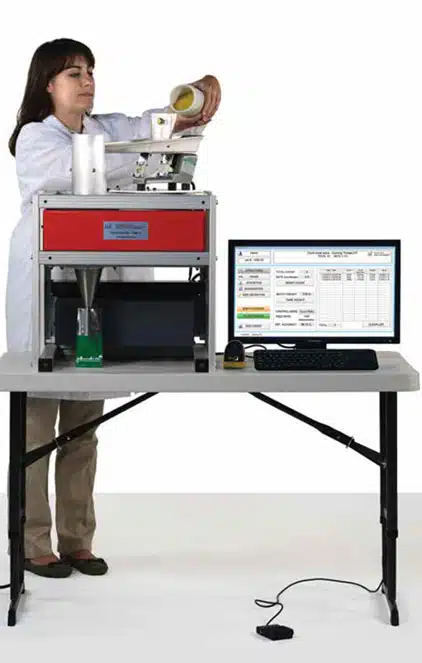
SEED COUNTER
Seed Counter: High-Speed Seed Counting Machine
The Ball Coleman Seed Counter counts and measures seed at up to 2,000 per second, from tiny lobelia to squash and corn. Two camera views separate overlapping seed, so counts stay precise lot after lot.
- Agronomic, vegetable and flower seed
- Counts and measures length, width and area
- Designed, programmed, built and supported in the US
SEED COUNTING MACHINE
What is a seed counter?
A seed counter is a machine that counts seeds automatically for packeting, breeding, research and testing. The Sciotex seed counter is a vision-based drop zone counter: seeds fall past a high-resolution camera that sees each one from two views, so it counts every seed, including seeds that overlap, and measures their size as it counts.
Counting seed by hand is slow, and counting by weight assumes every seed weighs the same, which is rarely true across varieties and lots. A vision seed counter counts each seed individually and records the result, so packet counts, trial counts and test samples are exact and repeatable.
What you get
- Imaging head with a high-resolution camera and 90-degree mirrors for two views of every seed
- Even light distribution for precise counts and measurements
- Touchscreen software with step-and-start operation
- Optional top load scale for weight per 1,000 seeds and seeds per gram
- Stored seed size specs and settings for each seed type
- Seed lot barcodes for fast changeover and traceability
- Downloadable measurement data: area, length and width
- Dashboard, operator accounts and fields for data such as purchase orders
HOW IT WORKS
How the seed counter counts and measures seed
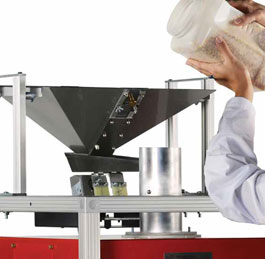
Seeds are fed into the drop zone, where a high-resolution camera captures each one from two views through 90-degree mirrors. Imaging software counts every seed, separates seeds that overlap, and measures each one as it passes.
1. Load the lot
Pour in the seed and scan or select the lot. Stored settings load for that seed type.
2. Image two views
The camera sees each seed from two angles, so overlapping seed is separated and counted correctly.
3. Filter by size
Minimum and maximum seed sizes keep debris and husks out of the count.
4. Count and record
Counts, seeds per second and size data are saved for the lot and can be downloaded.
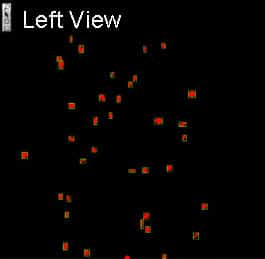
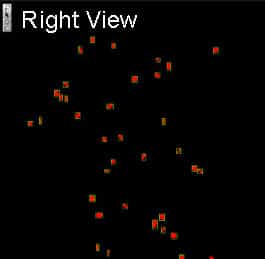
The software is designed to learn your seed types and store them, so the next lot of the same variety starts with the right settings. It captures small seeds such as lobelia as easily as large seeds such as pumpkin, and handles long, narrow seed that is difficult for many other seed counters.
SPEED AND PRECISION
How fast does the seed counter count?
No other counting machine we know of matches it for speed. Counting rate depends on seed size and shape, because larger and longer seeds take longer to fall through the drop zone one at a time.
Worked example: packet counts and repeatability
Counting 1,000-seed packets of marigold at 250 seeds per second takes 4 seconds per packet, before packet handling. For precision, two counts of the same 50,000-seed sample differed by only 0.16%, about 80 seeds, which is the kind of repeatability breeding and testing programs depend on.
FEATURES
Seed counter features
Fast
Up to 2,000 small round seeds per second, 200 to 300 oblong seeds and 80 to 100 large seeds per second.
Easy to use
Step-and-start operation on a touchscreen, quick changeover between seed lots and fewer moving parts for less downtime and maintenance.
Precise
Two views of every seed separate overlap. Two counts of a 50,000-seed sample varied by only 0.16%.
Lot data
Stores seed size specs, settings and seed lot barcodes. With the optional top load scale, also weight per 1,000 seeds and seeds per gram.
Measures as it counts
Downloadable statistics for seed area, length and width, plus a seeds-per-second counting function.
Built for daily use
Easier calibration, improved packaging settings, a dashboard, operator accounts and fields for data such as purchase orders.
APPLICATIONS
Who uses a seed counting machine?
Seed packeting and packaging
Exact counts per packet, with lot barcodes and packaging settings for fast changeover between varieties.
Breeding programs and research trials
Repeatable counts for plot packets, trial entries and research samples, with size data recorded for each lot.
Seed testing and quality labs
Fast, accurate counts for test samples, plus measurements of length, width and area for seed lot records.
Agronomic, vegetable and flower seed companies
One counter for a wide range of seed, from tiny lobelia to squash, corn and long, narrow seed types.
COMPARISON
Seed counting methods compared
| Method | How it counts | Limits | Best for |
|---|---|---|---|
| Hand counting | A person counts or tallies seeds | Slow, tiring and hard to repeat | Small, occasional counts |
| Counting by weight | Weight divided by an average seed weight | An estimate that drifts with seed size and moisture | Rough quantities of uniform seed |
| Vacuum or plate counters | A plate with holes picks up a fixed number of seeds | Fixed counts only; plates must suit the seed | Setting out fixed numbers, such as test replicates |
| Photocell (electronic) counters | Seeds break a light beam one at a time | Seeds that pass together can be counted as one | Moderate rates of free-flowing seed |
| Vision seed counter | A camera images each seed from two views | Exact counts, overlap separated, size measured | Packeting, breeding, research and testing |
Swipe the table to see all columns →
Vision counting is the only method in the table that counts every seed individually at high speed, separates overlapping seed and measures size at the same time. For how vision counting compares across all kinds of parts, see our counting systems guide.
SEE IT RUN
Seed counter video and brochure
Watch the seed counter count and measure seed, then request a demonstration with your own seed.

MORE FROM SCIOTEX
Counting more than seed?
The seed counter is one of a family of Sciotex vision counting machines. The same drop zone technology counts pellets, fasteners and other small parts.
FAQ
Seed counter FAQs
How fast does the seed counter count?
It counts round 1.25 mm pellets at up to 2,000 per second, oblong seed such as marigold at 200 to 300 per second, and large seed such as squash and corn at 80 to 100 per second.
How accurate is the seed counter?
Very. Two counts of the same 50,000-seed sample varied by only 0.16%. Two camera views let it separate overlapping seed, and minimum and maximum size limits keep debris and husks out of the count.
What seed types can it count?
It works with a wide range of agronomic, vegetable and flower seed, from small seed such as lobelia to large seed such as pumpkin, squash and corn, including long, narrow seed.
Does the seed counter measure seed size?
Yes. It measures seed as it counts, with downloadable statistics for area, length and width. With the optional top load scale it also records weight per 1,000 seeds and seeds per gram.
How quickly can I change between seed lots?
Seed size specs, settings and lot barcodes are stored, so changing lots is quick: scan or select the lot and start counting.
Can I see the seed counter count my seed?
Yes. Request a demonstration using the form on this page and we will show the counter running with seed like yours.
REQUEST A DEMO
See the seed counter count your seed
Tell us about your seed types and counts. We will set up a demonstration and answer your questions about the seed counter, options and support.
- Designed, programmed, built and supported in the US
- Engineering automation and vision systems since 1997

© Copyright 2026 by Coleman Technologies, Inc. DBA Sciotex