
Scientific Imaging Example
Adaptive Optics Microscope Software
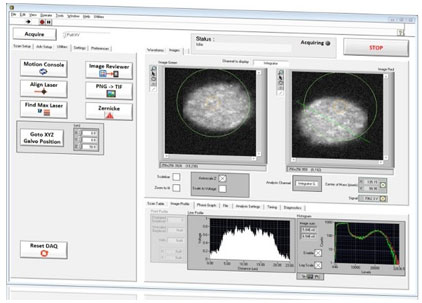
Control software for an adaptive optics two-photon microscope.
Researchers at the Howard Hughes Medical Institute developed a new way to use adaptive optics to see cells buried deep in tissue. Sciotex built the LabVIEW program that runs the two-photon microscope, analyzes the images and optimizes the adaptive optics to correct the aberrations. The work was published in Nature Methods.
Schedule a Free Scientific Systems Consultation
Custom-built microscope, intuitive interfaces
The SLM steers the beam back into focus
High-speed input and waveform output
Featured in Nature Methods
Example Overview
Software for an Adaptive Optics Two-Photon Microscope
What is adaptive optics microscopy?
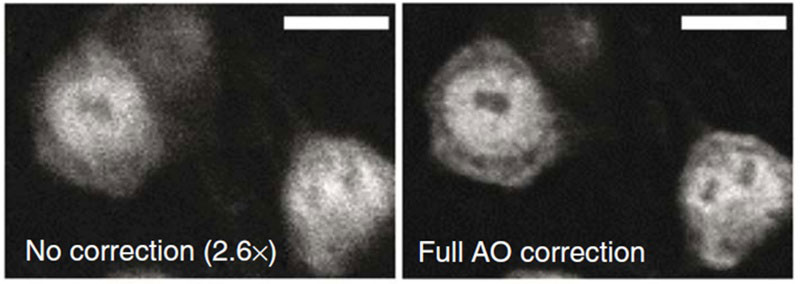
In biological imaging, the object of interest is not always in plain sight. Tissue covering the cells bends and scatters the light passing through it, preventing sharp images of the cells within. Adaptive optics, best known from astronomy, corrects these imaging aberrations.
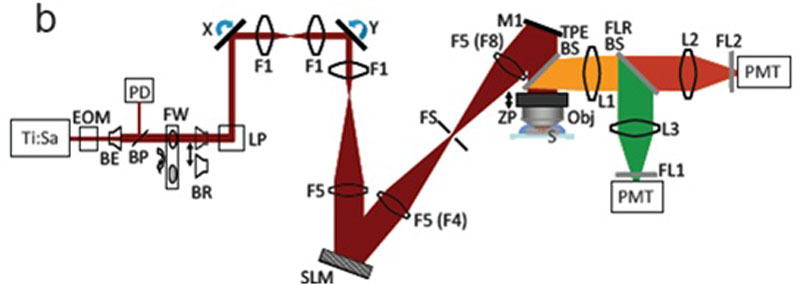
In this microscope, many images are first taken to characterize the aberrations that each light path through the sample experiences. A spatial light modulator then steers each part of the beam back into sharp focus. For the wider picture, see adaptive optics microscopy.
At a glance
- Instrument
- Custom two-photon microscope with adaptive optics
- Corrector
- 1,920 × 1,080 pixel spatial light modulator
- Platform
- LabVIEW with multiple NI-DAQ cards
- Sciotex role
- Instrument control, image analysis and AO optimization
- Published
- Nature Methods
Trusted by research and engineering teams at






How It Works
How the Microscope Corrects Aberrations
The software turns the microscope into a closed-loop system: it measures how the tissue distorts the beam, computes a correction and applies it before imaging.
Galvo mirrors raster the two-photon focus through the sample.
The SLM switches on one segment of the beam at a time.
Image shifts reveal how each segment is bent by the tissue.
The software computes a phase pattern and loads it onto the SLM.
The corrected beam returns to a sharp focus deep in tissue.
What the Software Does
Control Software Built for Adaptive Optics
The LabVIEW application runs the whole instrument, from acquisition modes to aberration analysis, with real-time control of every device.
Intuitive LabVIEW control
LabVIEW control of the custom-built two-photon microscope with intuitive user interfaces.
Multiple acquisition modes
Single scans, Z-stacks, calibration routines and adaptive optics scans.
Online review and analysis
Image profiling, image statistics and Zernike analysis of aberrations.
Synchronized, real-time hardware
SLM, Pockels cell, filter wheel, galvo mirrors and motion stages under one control, with parameters adjusted in real time.
Hardware and Software
Hardware Coordinated by the Software
Adaptive optics adds a corrector and a feedback loop to an already complex instrument. See microscope hardware synchronization for how this kind of timing works.
| Wavefront correction | 1,920 × 1,080 pixel spatial light modulator |
|---|---|
| Laser control | Pockels cell |
| Scanning | Galvo mirrors |
| Optics and motion | Filter wheel, beam reducers and motion-stage elements |
| Data acquisition | Simultaneous high-speed DAQ input and waveform output over the RTSI bus with multiple NI-DAQ cards |
| Processing | Multi-thread and multi-processor execution |
From two-photon to light sheet
Sciotex has since developed control software for adaptive optics in light sheet systems. Across its microscopy work, Sciotex has developed more than 30 custom microscope software applications for over 15 research institutions, including:
- Adaptive optics light sheet microscopes
- Lattice light sheet microscopes
- Adaptive optics lattice light sheet microscopes
- Multiview light sheet microscopes
Published research
The research behind this instrument was published in Nature Methods. Sciotex engineers have co-authored papers in journals including Science and Nature Methods.
Additional Resources
Learn More
Correcting Aberrations in Your Microscope?
Book a free consultation with a Sciotex engineer about adaptive optics, light sheet or custom microscope software.