
Process Control Example
Hot Dip Coating Simulator Control System for Steel Panels
Motion, heating, cooling and data logging for a 1/10th scale steel coating line simulator.
Sciotex developed control software for a 1/10th scale simulator of a steel coating facility. Steel panels move between heating and coating stations inside a sealed atmospheric chamber, and the software controls two-axis motion, infrared and induction furnaces and a gas jet cooler, using PID control and recipes to hold each panel to its programmed temperature profile.
Schedule a Free Consultation
Panels moved between stations
Two furnace types
Controlled cooling rates
Full temperature-time profiles
Example Overview
Simulating a Steel Coating Line at Lab Scale
What does a hot dip simulator do?
In continuous hot dip coating, steel strip is heated, annealed, dipped in molten zinc or alloy and cooled, and the coating’s quality depends heavily on that thermal history. Changing conditions on a production line is expensive and risky, so steelmakers use simulators that reproduce the process on individual panels.
The value of a simulator lies in how faithfully it reproduces the temperature profile over time. This system moves panels between stations in a sealed atmosphere and uses PID control of the furnaces and cooler to follow each recipe, so researchers can test new conditions and coatings at lab scale before trying them in production.
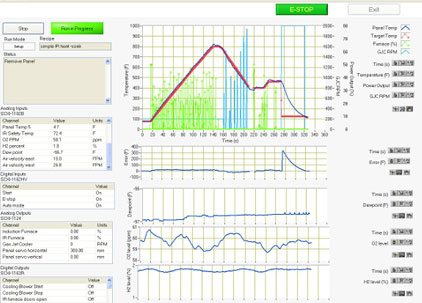
At a glance
- Scale
- 1/10th scale steel coating facility
- Motion
- Two-axis panel handling
- Heating
- Infrared and induction furnaces
- Cooling
- Gas jet cooler
- Control
- PID with user-defined recipes
Trusted by engineering and quality teams at






How It Works
How the Coating Simulator Works
The recipe defines the panel’s thermal history; motion and PID control make it happen.
Temperature profile and station sequence.
IR and induction furnaces heat the panel.
Two-axis motion carries the panel between stations.
Coating step, then controlled gas jet cooling.
Temperatures and events are recorded.
What the System Does
Software Built for Process Research
Reproducing a production thermal cycle on a single panel takes tight coordination of motion and heat.
Complete recipe control
Temperature over time plus heating and coating sequences.
PID optimization
Heating and cooling tuned to follow the profile.
Coordinated motion
Panels arrive at each station on time.
Data logging
Every run recorded for comparison.
Hardware and Software
System Capabilities
See the process control guide for how recipe and PID control work together.
| Simulator scale | 1/10th scale steel coating facility |
|---|---|
| Environment | Sealed atmospheric chamber |
| Motion | 2-axis |
| Heating | IR and induction furnaces |
| Cooling | Gas jet cooler |
| Control | PID with user-defined recipes |
| Data | Logged for every run |
Why recipes matter here
Recipes let researchers:
- Reproduce production thermal cycles
- Change one variable at a time
- Compare coatings under identical conditions
Need process simulation or test control?
Sciotex builds control systems for process simulators, furnaces and research equipment.
Additional Resources
Learn More
Simulating a Production Process?
Talk to a Sciotex engineer about process simulators and research control systems.